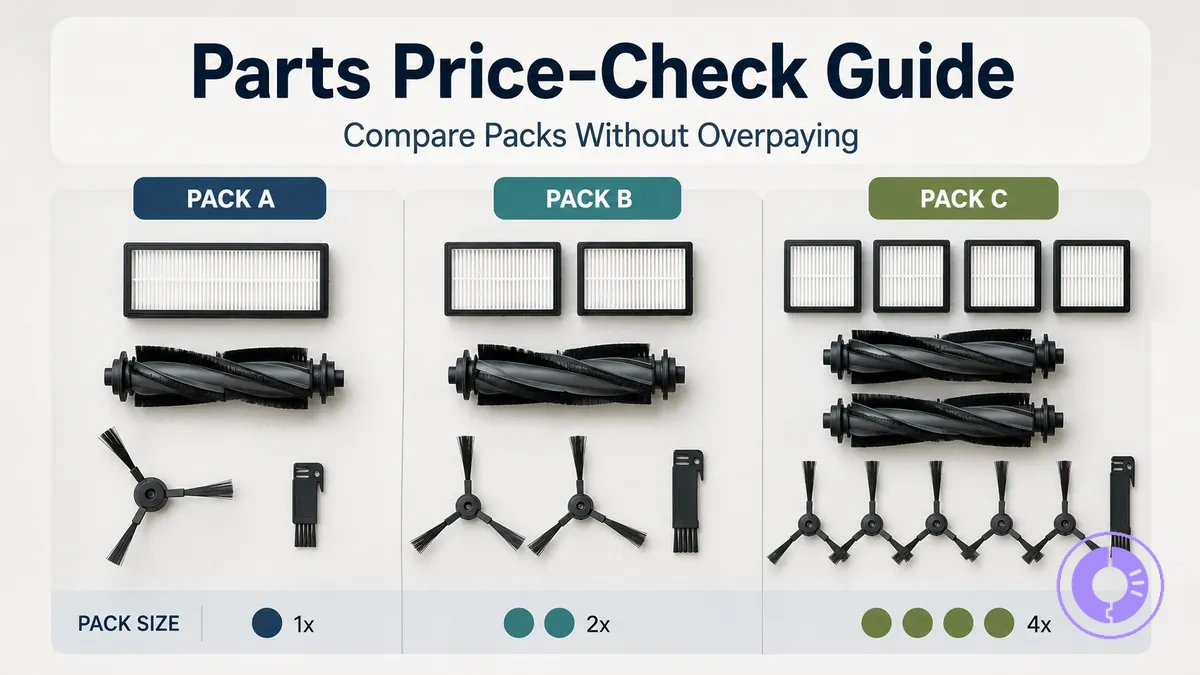
Roomba Replacement Parts Price-Check for Better Cost-Value Decisions
A Roomba replacement parts price-check compares offers by cost-value rather than the lowest sticker price. Cost-value means evaluating fit certainty, usable inclusions, and total delivered cost—these three factors make up the comparison unit for assessing cost-value.
A cheap listing may appear attractive but often results in mismatch, returns, or extra costs due to poor compatibility, fewer usable parts, or hidden fees like shipping and restocking.
Compare like-for-like offers by bundle composition and delivery terms.
When comparing offers, check these key factors:
- Compatibility with your specific Roomba series and model
- Usable inclusions—whether a single part or a bundle includes the filters, brushes, or other parts you need
- Return risk and seller terms that can add to the total delivered cost
Because model compatibility and bundle composition vary across offers, the lowest list price rarely indicates the best cost-value.
What counts as Roomba replacement parts for price comparing
Roomba replacement parts for price comparing are typically the consumables and wear parts that need regular replacement during normal use. They are comparable across offers when the listing disclosure specifies the fit, quantity, and part type.
Each listing typically includes a disclosure of the compatible series or model family and the pack size. Accessories such as docking stations, virtual walls, or cleaning pads are not considered replacement parts for price comparison purposes. For a broader overview of compatible parts, see the Roomba replacement parts hub. The image below labels the categories that count as Roomba replacement parts for price comparing.
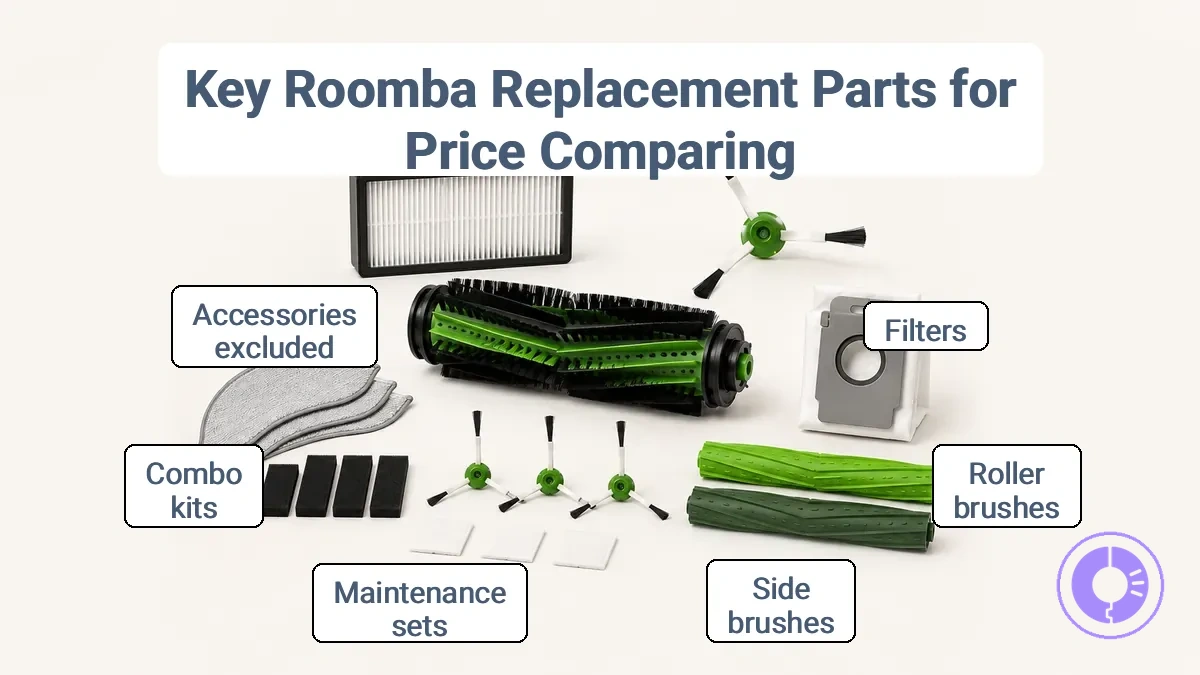
- Filters: Check the listing disclosure for pack quantity (e.g., 3-pack).
- Roller brushes: Confirm the compatible model family (e.g., e, i, j series).
- Side brushes: Verify the fit for your Roomba generation.
- Maintenance sets: Ensure the set is designed for your Roomba series.
- Combo kits: Verify each component's fit to your Roomba series using the listing disclosure.
When a bundle contains multiple part types, compare each category separately against single-category offers. The pricing driver can be the pack value and replacement cadence of each consumable type.
Consumables vs wear parts and why their pricing logic differs
The pricing difference between consumables and wear parts comes from their replacement frequency and wear behavior: consumables are replaced more often due to continuous degradation, while wear parts are typically built for longer use. This directly affects cost-per-use: a lower upfront price on a consumable may not mean lower overall cost when frequent replacements add up.
Heavy use increases the replacement cadence of consumables, making pack value comparisons more relevant. For example, replacement filters (consumables) need frequent swapping, while brush assemblies (wear parts) last longer. The pack value of consumables depends on usage intensity; larger packs may reduce per-unit cost only if the expected consumption justifies it. Wear parts have a slower degradation pattern, so their higher individual price often yields a lower cost-per-use over time, and bundle evaluations must account for these differing wear patterns and replacement frequencies.
Genuine vs third-party parts as a controlled price variable
The choice between genuine and third-party parts is treated as a controlled price variable rather than a universal recommendation. What tips the scale depends on fit certainty, consistency, compatibility, and return or warranty terms offered by the seller. The price premium for genuine parts buys more predictable fit and long-term consistency, while the risk premium for third-party parts is lower upfront cost paired with variable outcomes.
The table compares the main risk and utility drivers, showing how these factors shift the cost-value equation while keeping comparisons fair.
| Option | What changes | Cost-value trade-off | When it's acceptable |
|---|---|---|---|
| Genuine (OEM-style) parts | Higher fit certainty and consistency; limited variability | Price premium buys more predictable performance and longer durability; lower risk of repeated labor costs | When the part is critical for safety, warranty compatibility, or long-term ownership |
| Third-party (aftermarket) parts | Fit and consistency may vary by brand and batch; return terms and warranty differ | Lower upfront cost but higher uncertainty; risk premium depends on quality tier and seller | For non-critical wear items or when the seller offers clear return terms and warranty |
Understanding these differences helps keep genuine vs third-party trade-offs fair when comparing prices across sellers. A third-party part with poor fit or early failure can push the overall cost above the initial savings. Return terms and warranty support from the seller become decisive, reinforcing the need to evaluate each purchase against its own risk profile.
The price drivers behind similar-looking Roomba parts offers
Similar-looking Roomba parts offers can deliver very different cost-value because price drivers such as compatibility specificity, build quality, material signals, seller terms, and bundle composition affect fit, durability, and total ownership cost.
To avoid overpaying, apply a short checklist that verifies these drivers across offers, ensuring a like-for-like comparison and revealing long-term cost.
The annotated example highlights the key listing fields to compare.
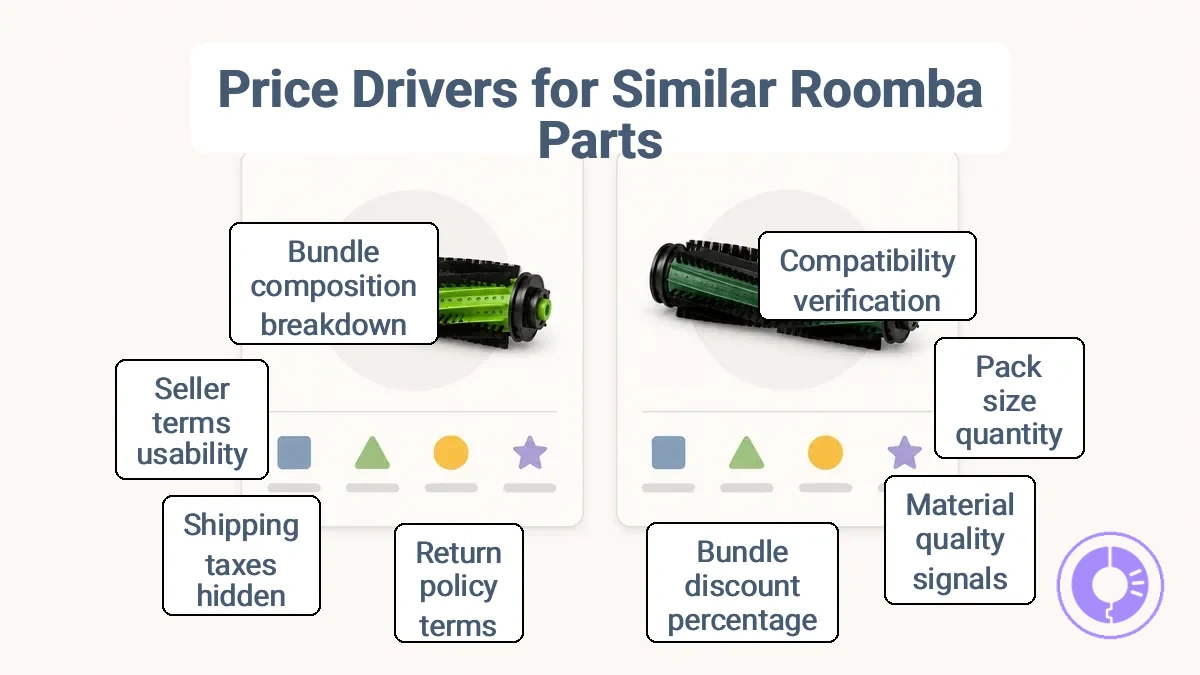
- Model/series coverage statement – a mismatch changes fit and return risk.
- Pack size and quantity of each component type – miscalculating usable inclusions changes the per-unit price.
- Material signals in the title or description (e.g., rubber, foam) – softer materials may change wear behavior and cost-per-use.
- Bundle discount language (e.g., “bundle and save”) – comparing discount percentages across offers changes the effective value.
- Return policy disclosure – restrictive terms change the risk of a bad fit.
- Shipping and taxes indicator – hidden costs change the total price paid.
- Disclosure of seller terms (e.g., included screws or packaging) – missing fasteners changes immediate usability.
- Breakdown of bundle composition (individual vs. combo sets) – fewer usable inclusions change the apparent value.
For instance, a listing that fails to disclose the exact model series it fits may appear as a bargain until the buyer receives a part that does not mount correctly. The missing disclosure can turn the apparent saving into a net loss once return shipping, restocking fees, or time lost is considered, showing why verifying before comparing matters.
A listing with the lowest price does not automatically deliver the lowest cost per use.
Material quality and usable inclusions matter more, and a well-priced listing with clearly stated compatibility and solid construction often has lower cost-per-use than a rock-bottom offer with vague details, making compatibility verification the first step in evaluating any Roomba parts offer.
Model-series fit and version-specific compatibility effects on cost
A mismatch between the replacement part and the Roomba model series can increase cost due to return risk and the need to re-buy. Verify the series listed in the product description against your unit’s model number before ordering. A part that fits one series may not fit another, even when the physical shape looks similar.
Check these listing details to reduce mismatch:
- Explicit series mention (e.g., e/i/j series or 600-series range) in the fit statement
- Model-number range or specific model list in the compatibility note
- Fit statement specificity — avoid listings that claim broad compatibility without naming series
- Return policy for incorrect-fit parts
- Re-buy cost if the part does not match
Overly broad compatibility claims, such as “accessory kit” listings that span many model numbers, can be a mismatch risk cue. Do not compare prices until the fit is confirmed against the model series.
Build and material differences that change lifespan and cost-per-use
Build quality and material differences in replacement parts like filters and brushes affect how long each component lasts and how its cost-per-use compares to cheaper alternatives.
Tolerances in brush roller housings and filter edges affect how well the part fits and seals against debris.
Material quality matters: rubber rollers with stiffer compounds can grip carpet fibers more effectively but may harden quicker on hard floors, while softer foam brushes may wear faster under high daily use. Filter material density and fiber integrity can affect how much clogging occurs over time, especially in dusty or pet-heavy homes.
Wear behavior varies by floor type and usage intensity. On hard floors, bristle brushes may shed fibers earlier if run over rough surfaces; on carpet, the same brush may last longer because the fibers flex differently. The frequency of cleaning cycles changes how quickly parts degrade — running the robot multiple times per day can accelerate wear on both rubber components and filter media.
- Filters (nylon vs polyester): Nylon filters often maintain airflow longer than polyester equivalents in moderate dust conditions, but polyester may resist moisture better in humid environments.
- Brush rollers (rubber vs bristle): Rubber rollers show less bristle shedding over time, but on thick carpet they may need more frequent cleaning to avoid hair wrap; bristle rollers can lose shape faster on hard floors.
- Side brushes (soft vs stiff bristles): Stiffer bristles can push debris more effectively on smooth surfaces but may break or bend sooner on uneven flooring.
Seller Terms and Listing Clarity as Hidden Cost Components
Seller terms and listing clarity contribute to hidden costs because unclear policies on returns, warranties, and shipping can add unexpected fees. Checking these details before checkout reduces the risk of cost surprises.
- Return window and restocking fees: How long do you have to return an incompatible part? A short or unclear return window can lead to high costs if you end up with a non-refundable part.
- Warranty coverage clarity: Is the part covered against defects? Unclear warranty terms can lead to unexpected costs if the part fails and the coverage excludes common issues like wear or misuse.
- Shipping costs and timing: Does the listing include shipping fees or add them at checkout? Expedited shipping, especially for parts needed quickly, can significantly raise the total cost if not clearly disclosed.
- Disclosure of part condition: Does the listing specify whether the part is new, refurbished, or used? Unclear condition descriptions can result in receiving a part that does not match expectations and may require a return with additional fees.
- Compatibility claims accuracy: Does the seller list specific Roomba models and series? Unclear compatibility information can lead to ordering a part that does not fit, triggering return costs and delay.
- Packaging and included accessories: Does the listing mention what is included (screws, adapters, manual)? Missing components may require separate purchases, adding hidden cost.
Setting a baseline price before you compare offers
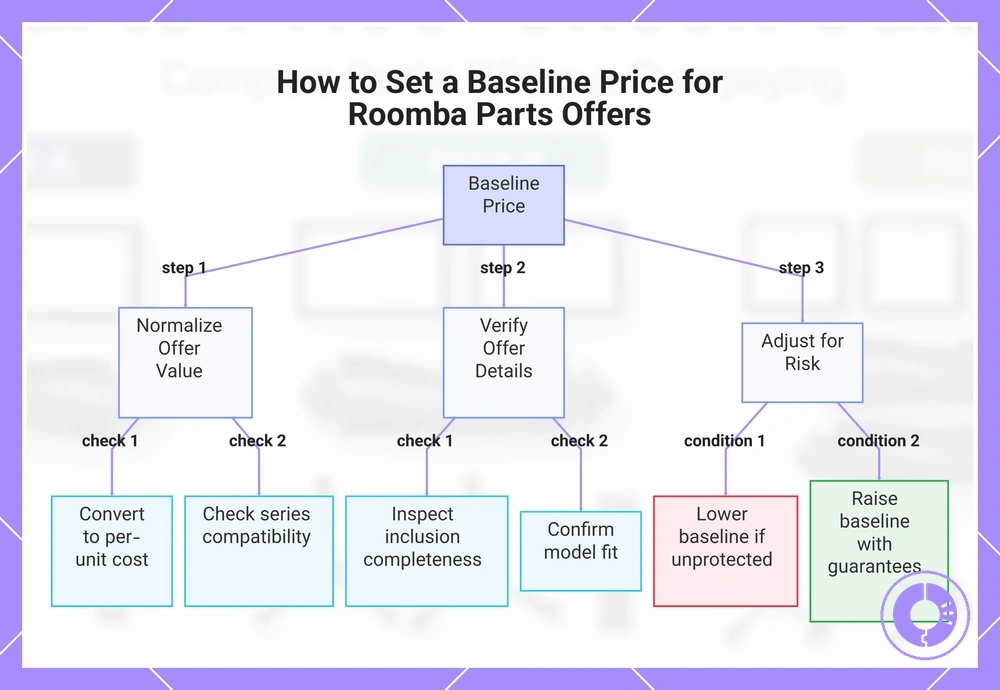
Setting a baseline price before comparing offers helps you avoid extreme anchoring by establishing a reference point before evaluating any single listing. To build a baseline, gather inputs that reflect what the offer actually includes, not just the headline price.
- Normalize by pack size and compatibility scope. Offers often list a total price for a multi-pack or a bundle that covers several models. Convert each offer to a per-unit cost and check which Roomba series the parts fit. A 3-pack that works across multiple series may carry a different baseline than a single part limited to one model.
- Check inclusion completeness. Some offers include mounting hardware, filters, or edge-sweeper brushes; others sell those separately. Compare what is actually in the box. An offer that appears cheaper may require additional purchases to match the same functionality.
- Review typical terms. Look at return windows, warranty coverage, and whether the seller describes the part as OEM, compatible, or generic.
- Confirm your model fit. The same part number may fit some Roomba models but not others. Verify compatibility using your model number before you lock in a baseline. A part that does not fit is unlikely to be a good deal at any price.
Baseline ranges should adjust when compatibility certainty or return risk changes. If a seller offers a clear compatibility guarantee and a no-questions return policy, the baseline can move slightly higher because the risk is lower.
If the listing lacks those protections, the baseline should reflect that added uncertainty.
This chart shows the main steps and checks to establish a fair baseline price before comparing Roomba parts offers.
Reference pricing signals that reduce overpaying without anchoring to extremes
Reference pricing signals are repeatable cues within product listings that help buyers identify a reasonable price range without relying on a single extreme anchor. Unlike traditional price anchoring—which uses a high initial price to shape perception—reference signals depend on verifiable listing features like pack size, inclusion details, and compatibility phrasing. These cues become useful when the buyer has no prior benchmark, especially for replacement parts where prices vary widely.
Clear, consistent signals from sellers support a reasonable reference range, while vague or inflated listings may signal a padded price. Each signal is paired with a protective outcome—helping the buyer avoid mismatched parts, unnecessary extras, or false deals.
- Series compatibility line – A phrase like “for Roomba 600 series” may indicate the part is designed for a specific robot generation, helping avoid a costly mismatch.
- Pack size count – The number of units explicitly stated (e.g., “3-pack”, “10-pack”) may indicate the total quantity, protecting against overpaying for a single item when multiple are expected or buying more than needed.
- Bundle or discount language – Words like “accessories kit”, “value pack”, or “replacement set” may indicate the listing includes multiple components, helping avoid a false deal when the extras are low‑quality or unnecessary.
- Inclusion wording – Phrases like “parts kit” or “full replacement set” may signal that the price covers a complete assembly, reducing the risk of buying a single component at a premium.
- Disclosure quality – A detailed description that specifies material, dimensions, or compatibility notes may indicate a transparent seller, helping avoid listings that obscure missing details behind a low or high price.
- Genuine or OEM indicator – Terms like “genuine”, “OEM”, “original” may indicate the part meets manufacturer specifications, helping avoid a lower‑quality substitute that could compromise performance.
- Condition disclosure – Labels like “new”, “refurbished”, or “open box” may indicate the product state, helping avoid confusion when a low price reflects used or damaged goods.
- Warranty or return terms – A stated warranty or return period may indicate seller confidence, helping avoid overpaying for a part that cannot be returned if it does not fit.
Total delivered cost checks: shipping, taxes, and return risk
Total delivered cost is the figure to compare when evaluating replacement-part prices across sellers.
This table organizes cost components by how they affect your decision, letting you spot hidden differences between offers.
| Cost component | What it covers | Risk effect |
|---|---|---|
| Shipping | Charge to deliver the part from seller to you | A high shipping cost can make a cheaper listing more expensive overall |
| Taxes | Sales tax or other destination-based taxes | Tax rates vary by location and add to the total cost |
| Delivery time | Speed of shipping and expected arrival date | Faster options may cost more, and delays can affect your repair schedule |
| Return shipping | Cost you pay if the part needs to be sent back | Unexpected return shipping can erase any savings from a low initial price |
| Restocking | Fee deducted from refund when returning an item | Restocking fees reduce your refund, increasing the effective cost |
For example, a seller with a slightly higher price but free returns and no restocking fee may cost you less overall than a cheaper seller that charges heavy return shipping and a restocking fee.
Kits and bundles vs single parts: comparing value per replacement cycle
Value per replacement cycle normalises the cost of a kit, bundle, or single part by dividing its price by the number of usable replacement cycles it covers, so you evaluate options based on what you actually use per maintenance round rather than upfront discount size or the number of items in the package.
A bundle that contains three filters and two brushes may look cheaper per item, but its real value depends on whether the included quantities match your model's replacement schedule and whether every component fits your specific series. Check the kits vs individual parts decision for when a kit outperforms individual parts.
When your robot needs only one filter and one brush per cycle, the extra filter becomes surplus that does not reduce your next purchase. For example, a 'build your own bundle' that lets you pick only the parts your model needs often delivers higher value per cycle than a fixed bundle that includes a brush type your series does not use.
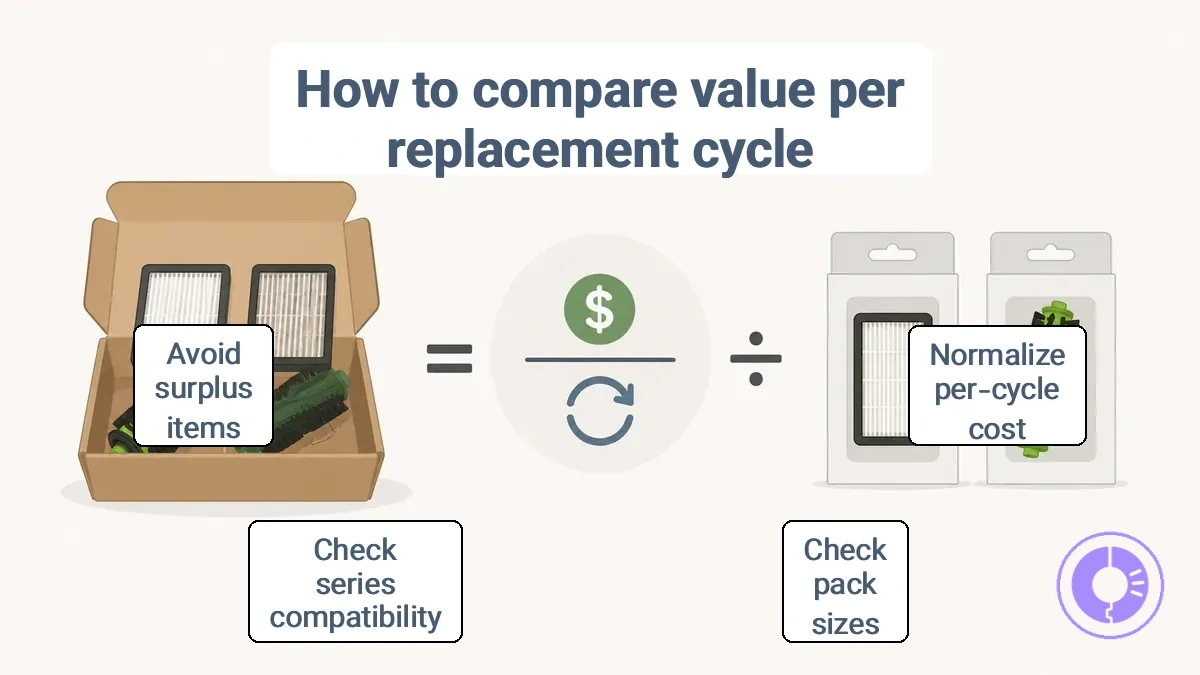
To compare kits, bundles, and single parts fairly, check two fields: pack sizes and series compatibility scope.
- Pack sizes: A 6-pack of side brushes may cover six cycles for one model but only three cycles for a model that uses two brushes per replacement.
- Series compatibility scope: Similarly, a kit labelled for the 500 series may include parts that do not fit the 600 series, reducing its usable cycles to zero for that robot.
Filter packs: pack size, filtration level, and value consistency checks
A filter pack's value comes down to how its pack size, filtration level, and replacement cadence match your system's requirements.
Start by checking the nominal size and actual dimensions listed on the product page, since filters in the same series can vary slightly in fit. Use this mini-checklist for like-for-like comparisons before buying.
- Pack size and series fit note. Confirm the pack includes the correct number of filters for your replacement schedule, and check that the series or model number matches your system. Packs within a product line can cover multiple sizes.
- Filtration level and rating consistency. Compare the MERV, MPR, or FPR rating across packs. A higher rating may capture finer particles but can also increase airflow resistance, so the right level depends on your system and air quality needs.
- Replacement cadence and value. Calculate the cost per filter and the recommended replacement interval. A lower per-filter price may not save money if the filter needs more frequent changes than a slightly more expensive option.
Verifying pack size, fit notes, and filtration ratings helps prevent mismatches that could lead to early replacement or reduced performance.
Roller brush packs: wear patterns, fit precision, and expected utility
Roller brush value depends on fit precision and wear behavior, not only quantity. A brush roll that fits securely in the cleaning head prevents slipping and uneven agitation, while the bristle material's resistance to matting affects how consistently debris is picked up across multiple cleaning cycles.
Brush rolls that loosen over time create uneven wear at the edges, reducing utility per cleaning cycle. Wear patterns vary with floor surface. Brush rolls with stiffer bristles tend to hold their shape longer on hard floors, whereas softer bristles used on carpets flatten faster, limiting effective re-use. Debris type influences wear: pet hair can tangle around bristles more quickly, making brush rolls with rubber fins a common option for homes with pets.
The table compares brush type, floor surface, wear pattern, and expected utility per cycle. Inspecting the connection between brush roll and end caps before each use helps avoid mid-cycle performance drops.
| Brush Type | Floor Surface | Wear Pattern | Expected Utility per Cycle |
|---|---|---|---|
| All-rubber fins | Hard floors, low-pile carpet | Minimal bristle damage; stays intact | Often lasts through multiple cycles on same surface |
| Bristle + rubber | Medium-pile carpet | Moderate bristle wear; some tangling | Usually suitable for several cycles if cleaned regularly |
| Full-bristle | High-pile carpet, pet hair | Fibers flatten and tangle quickly | May require replacement after one heavy-use cycle |
Side Brush Packs: Breakage Rate, Fit Variability, and Real Bundle Value
Breakage rate, fit variability, and cost-per-use determine a side brush pack's value.
To avoid overpaying for fragile or mismatched parts, go through this checklist before choosing a bundle:
- Check mount type and series compatibility first. Side brushes are not universal—shape, clip, and screw placement vary by model. Confirming fit before purchase prevents wasted expense.
- Assess material flexibility vs. breakage risk. Stiffer brushes tend to snap faster on hard floors, while more flexible ones may wear more quickly on carpets. Choose material based on your typical room conditions to improve durability.
- Count usable inclusions vs. padding. Some bundles include extra brushes that seem like a deal but may be thinner or made of less durable material. Consider the total usable brushes for your setup, not just the quantity listed.
- Compare cost-per-use, not cost-per-pack. A slightly more expensive pack with stronger, well-fitted brushes often outlasts a budget option, reducing long-term costs.
Maintenance sets: what inclusions make a bundle cost-effective
A maintenance set is cost-effective only when its inclusions match replacement-cycle needs, delivering real savings rather than a perceived discount.
The table below groups typical maintenance set inclusions by replacement frequency and practical usefulness. This helps buyers see whether a bundle is genuinely useful or padded with low-value items.
| Inclusion Type | Replacement Frequency | Usefulness to Customer | Value Outcome |
|---|---|---|---|
| High-wear components (e.g., filters, belts, seals) | Every 1–3 cycles | Essential for continued operation | Directly reduces separate purchase cost; can make the bundle worthwhile |
| Lubricants or cleaning aids | Variable, often every 2–4 cycles | Convenient but can be bought individually at low cost | Adds marginal value; may justify a slightly higher bundle price if included |
| Low-use specialty tools (e.g., alignment fixtures, measuring gauges) | Once or rarely | Useful only during specific repairs | Increases bundle cost without ongoing need; often perceived as filler |
| Duplicate items (e.g., two identical gaskets when one is needed) | N/A | Creates unnecessary redundancy | Inflates total piece count and price without proportional utility; erodes cost-effectiveness |
The completeness of the set matters: missing a commonly replaced filter or including duplicate low-value items erodes cost-effectiveness. Padded sets—where low-use or duplicate items raise the price—may appear comprehensive but often fail to match real replacement-cycle needs, making them less economical than buying only the necessary parts individually.
Offer-quality checks that keep comparisons like-for-like
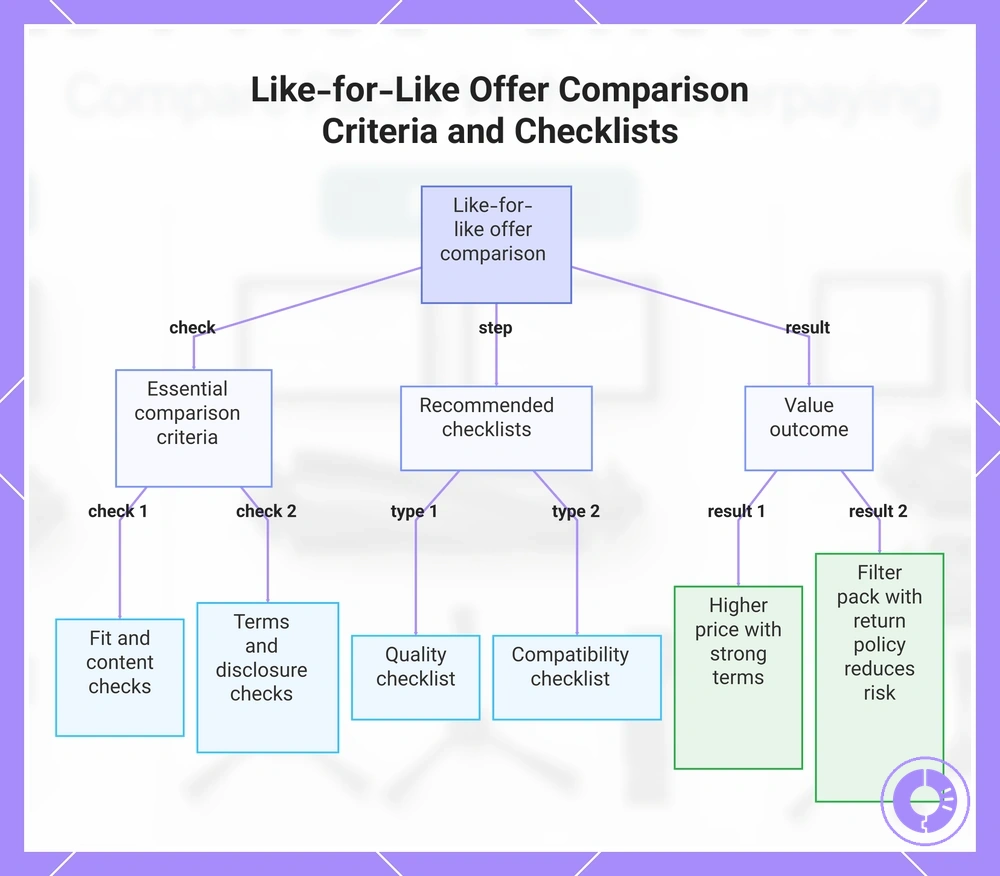
Like-for-like checks help prevent false bargains when a lower-priced offer costs more due to a mismatch, missing items, or weaker terms.
Apply these criteria as a comparison standard before comparing prices.
- Compatibility proof: Verify the part fits the exact Roomba series and model number.
- Inclusion clarity: Confirm what is included (e.g., filter, brush, screws) and whether it is a single unit or pack.
- Return terms: Check return policy, restocking fees, and warranty length.
- Disclosure completeness: Ensure all conditions and exclusions are stated upfront.
Use a quality checklist to compare like-for-like to standardize these criteria, and a compatibility checklist before price comparing to verify fit.
A slightly higher-priced offer with free returns and a longer warranty can be better value than a cheaper offer with no return option and a short warranty.
For example, a filter pack that costs a bit more but includes a no-questions-asked return policy reduces the risk of wasted expense if the part does not fit as expected.
This chart shows the essential criteria for comparing offers fairly, the recommended checklists to use, and the value outcome of considering terms and policies.
Compatibility confirmation checks that prevent wasted purchases
To avoid wasted spend, confirm two things: a series or version match and an explicit fit statement.
Consider this a pre-purchase check before adding any part to your cart.
- Series or version match. Check that the part number covers your specific model series (e.g., e, i, j, or 600-series ranges). A generic brand filter alone isn't enough—manufacturers often release multiple incompatible versions under the same brand.
- Explicit fit statement. Look for a clear yes/no fit note on the product page (e.g., 'Fits Roomba 890'). Steer clear of listings with overly broad wording like 'fits many models' or 'works with all Roombas' — these are stop-and-verify triggers that raise the risk of receiving a non-fitting part.
Checking both before checkout reduces return costs and wasted time from incompatible parts.
Quality signals to verify before buying: labeling, fit notes, and return terms
Quality signals are buyer-visible cues on listings that reduce comparison risk by providing verifiable information about labeling, fit-note details, and return terms. These cues help you assess expected value and control risk before committing to a purchase.
Labeling signals such as batch numbers, expiration dates, and COA references indicate product tracking and testing, but do not guarantee later performance.
Fit-note specificity matters when a product includes a compatibility note. A valid fit note states compatible models or dimensions. Notes that lack specific fit details may not match your device. Fit notes are not a guarantee of exact fit and should be verified against your product's specifications.
Return term clarity, such as stated return windows, condition requirements, and refund policies, directly affects risk control. Clear terms let you decide what to do if the product does not match expectations, without relying on packaging promises.
- Batch number and expiration date on the label
- QR code or URL linking to an independent lab COA
- Date labeling phrases such as 'Best if Used By' or 'Sell-By'
- Fit note including compatible model numbers or dimensions
- Return policy stating time limits, condition rules, and refund method
Bundle math checks: quantities, duplicates, and missing items inside sets
Bundle math checks usable quantity and completeness instead of raw item count. It catches padded sets where extra items inflate the count without adding value per replacement cycle.
- Check that each component appears only once unless the set explicitly states multiples.
- Check for missing high-frequency parts: make sure components you replace most often, like filters or brushes, are included in the expected quantity.
- Normalize by pack size: if the bundle uses multi-pack or bulk packaging, adjust the count so you compare apples to apples with stand-alone replacements.
Budgeting replacement parts as a recurring maintenance cost
Budgeting for replacement parts treats them as a recurring cost that depends on usage intensity and part type, spreading the cost over time for straightforward financial planning.
The replacement schedule for budgeting for each part is a key factor.
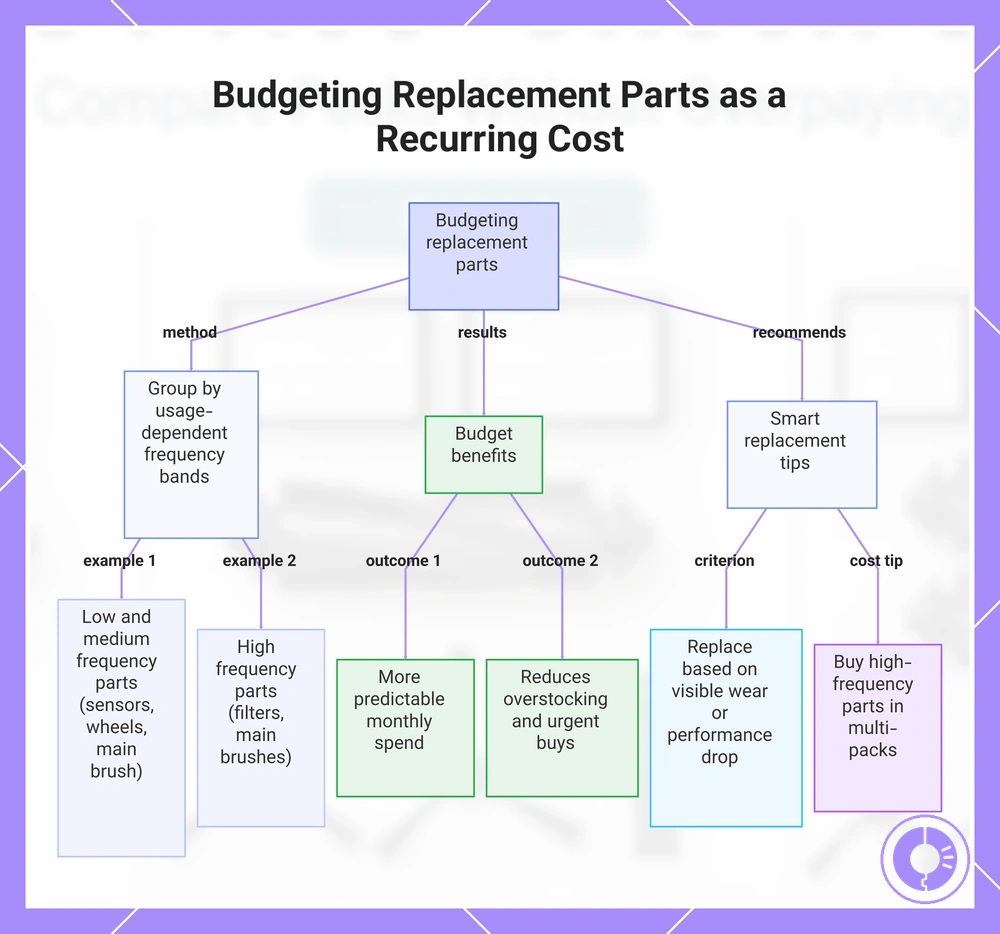
One way to organize the budget is to group parts into frequency bands. These bands are not fixed but depend on your room size, pet hair level, and cleaning habits. Common bands include:
- Low-frequency parts – side brushes, wheels, and sensors often last longer and may need replacement less often, sometimes every few months.
- Medium-frequency parts – main brush assemblies and dust bin filters often require attention more regularly, with replacement intervals that can vary based on debris load.
- High-frequency parts – filters and main brushes are typically consumed fastest and may need frequent swaps, sometimes every few weeks in heavy-use homes.
When parts are grouped this way, the budget becomes more predictable: high-frequency parts may account for a larger share of monthly spend, while low-frequency parts create occasional peaks. This reduces overstocking, mismatch risk, and urgent buys.
Instead of relying on fixed calendar intervals, keep recommendations criteria-based: replace parts when they show visible wear or when cleaning performance drops. For example, buying filters and main brushes in multi-packs instead of individually can shift the monthly cost for these high-frequency parts. The total spend over a year may remain similar, but the monthly outlay can become more consistent, reducing budget surprises.
This chart shows how to budget for replacement parts by grouping them into usage-dependent frequency bands, the resulting budget benefits, and smart replacement tips.
Grouping purchases by replacement frequency to reduce total cost
Grouping purchases by replacement frequency reduces emergency buying when needs are stable.
The savings depend on whether the grouped items are needed at the same time and whether the supplier offers volume discounts for consolidated orders.
- High frequency – Parts replaced every few months, such as filters or brushes. Grouping these can help keep pricing consistent and reduce order processing costs.
- Medium frequency – Parts replaced annually or semi-annually, like batteries or sensors. Grouping these with other medium-cycle items may lower shipping and handling costs.
- Low frequency – Parts replaced every few years, such as motors or main boards. Grouping low-frequency purchases is typically less beneficial.
The stability of replacement frequency can affect total costs.
When frequency is uncertain, grouping may lead to excess inventory.
When buying a bundle now is rational vs staggering purchases later
Whether buying a bundle now makes sense depends on frequency certainty, fit certainty, and return risk — these factors help weigh upfront savings against the mismatch or non‑use risk that bundles can carry.
Each criterion works as a decision signal, not a strict rule, indicating whether bundling or staggering fits your situation.
- Frequency certainty: If you know you will need multiple items or refills within a predictable period (e.g., replacement filters for the same model), a bundle can lock in a lower per‑unit price without waste. If your usage is sporadic or uncertain, staggering purchases avoids paying for items that may never be used.
- Fit certainty: When you are confident that each item in the bundle matches your device model, configuration, or specifications, bundling can reduce per‑unit cost. If fit is uncertain (e.g., different generations of parts, or compatibility depends on minor variations), buying individually lets you verify fit one at a time.
- Return risk: Bundles may carry stricter return policies or higher restocking fees. If return risk is low (the items are standard and low‑cost), the convenience of a bundle may justify the discount. If return risk is high (expensive items, model‑specific parts, or unclear return windows), staggering purchases can protect you from paying for unusable items.
The decision depends on your stability of need and your specific situation.
Pricing traps that cause overpaying for Roomba replacement parts
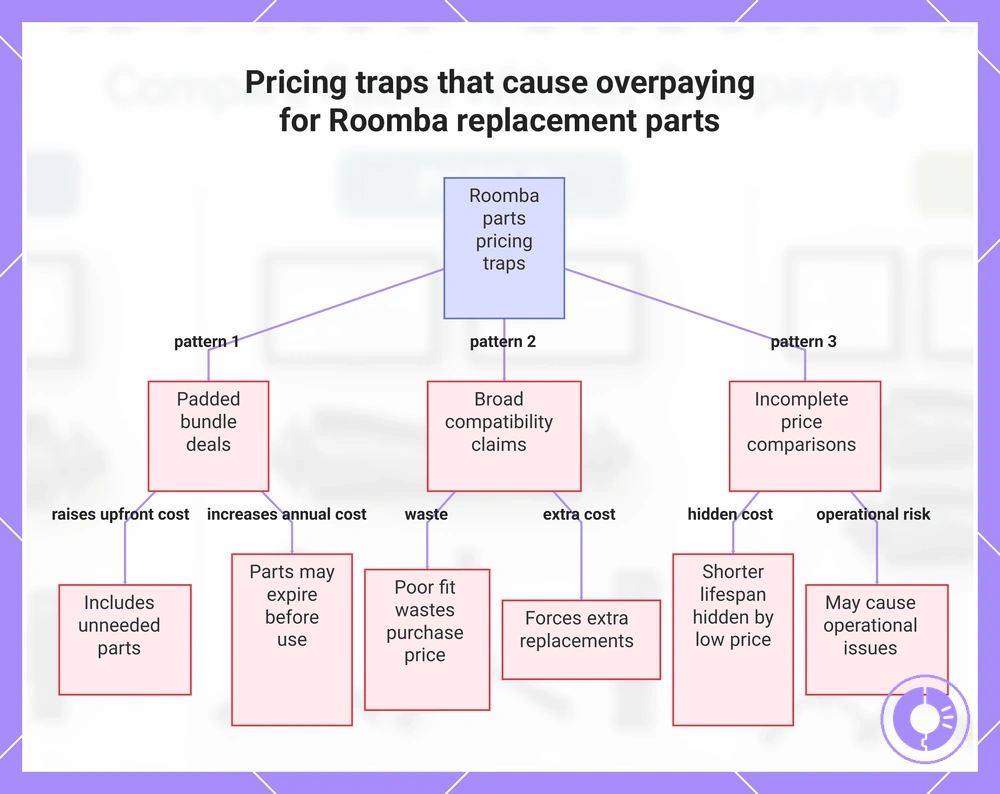
Pricing traps are patterns that inflate how much you spend on Roomba replacement parts—through product mismatch, padded bundles, or incomplete price comparisons.
Common overpay patterns include:
- Padded bundle deals: often group parts with items you may not need yet, raising upfront spend and annual costs if parts expire.
- Broad compatibility claims: can lead to poor fit, resulting in wasted purchase price and the need for additional replacements.
Incomplete price comparisons cause overpaying when buyers ignore lifespan or fit. A lower-priced third-party brush may wear out faster or cause operational issues, increasing total expenditure over time.
Recognizing these patterns helps buyers confirm fit and skip unnecessary bundle items.
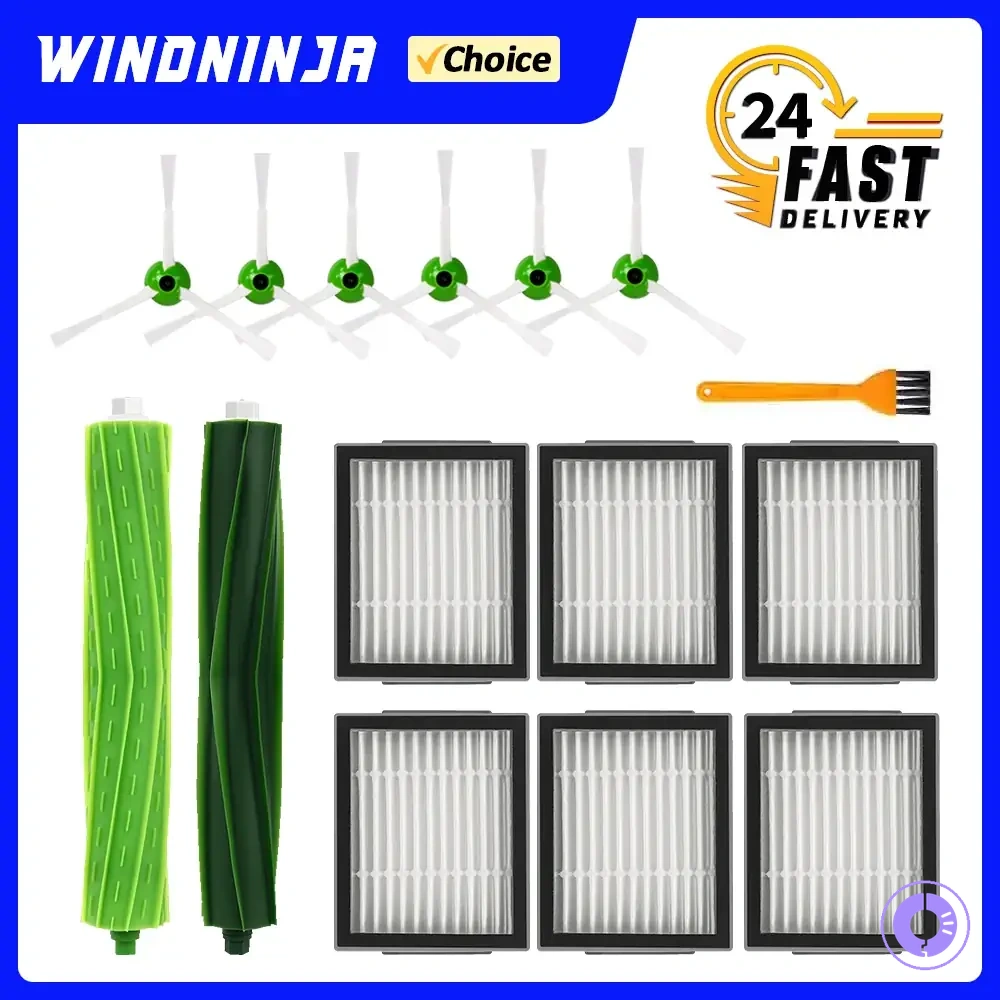
Here are product examples that may make comparison easier. Before buying, always review the compatibility criteria, essential features, and product details.
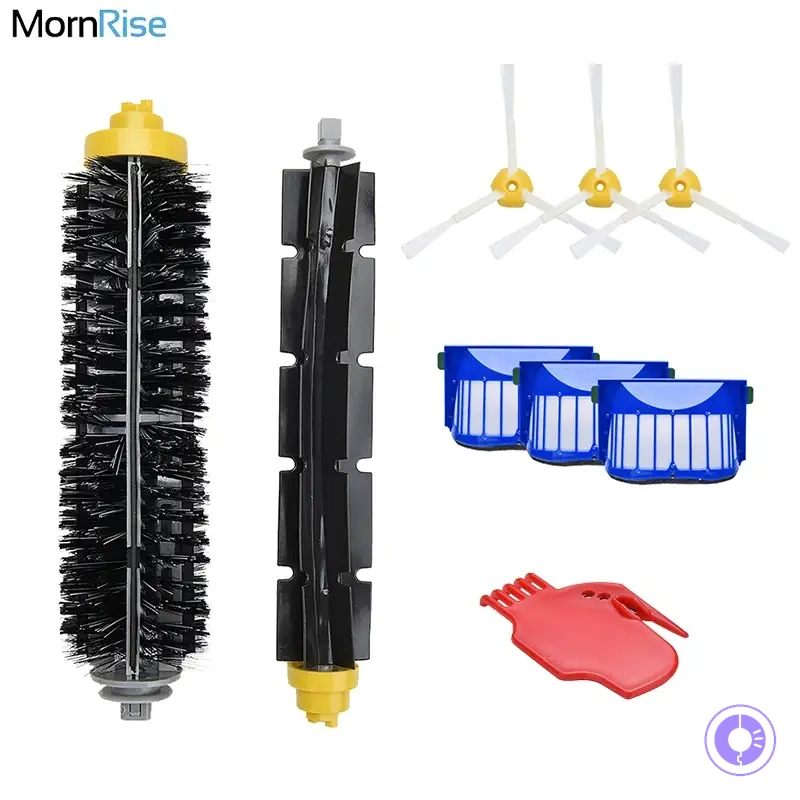
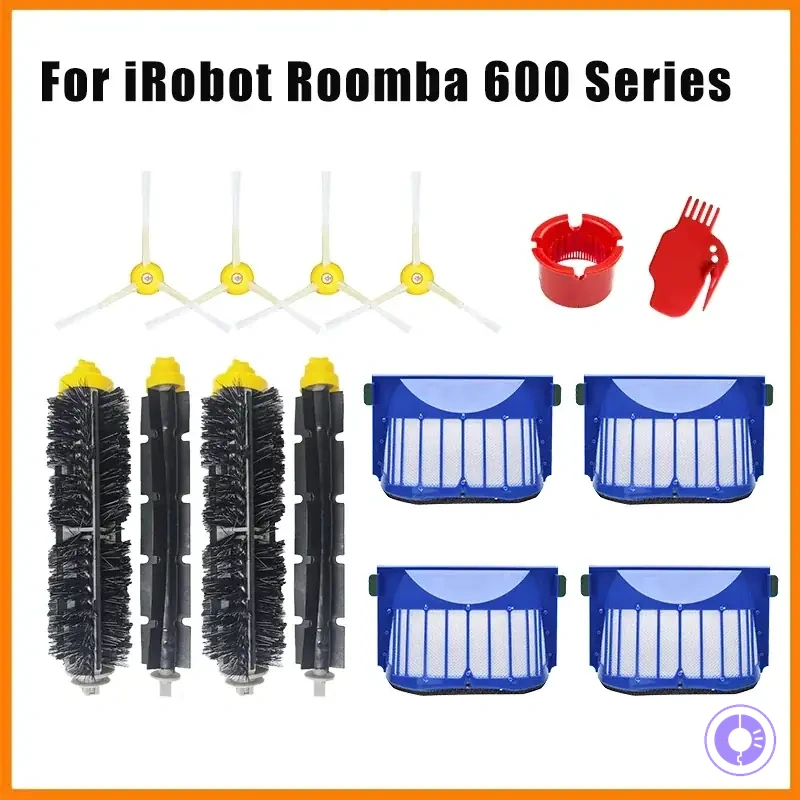
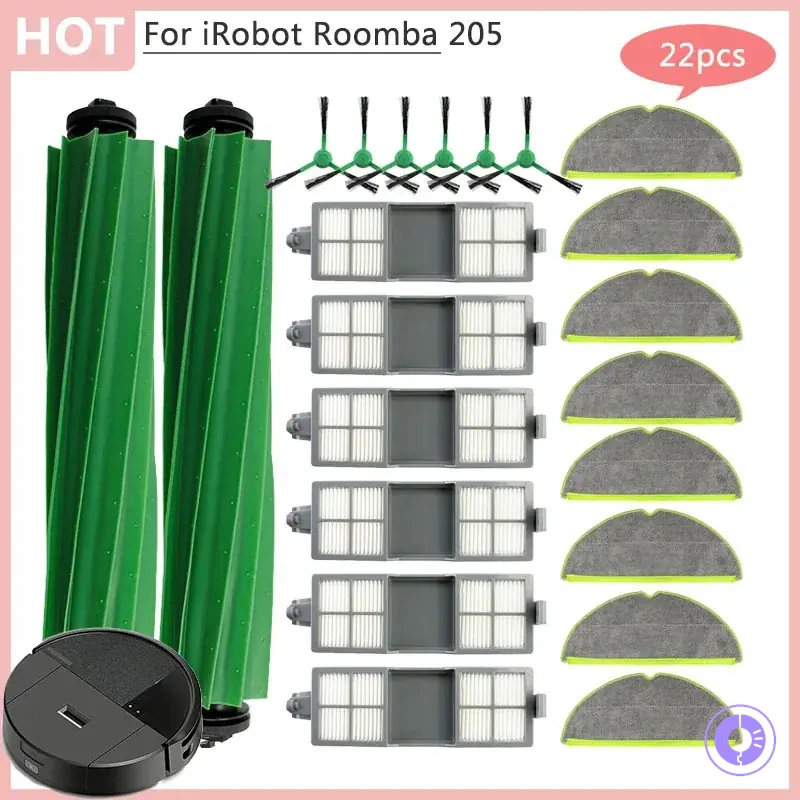
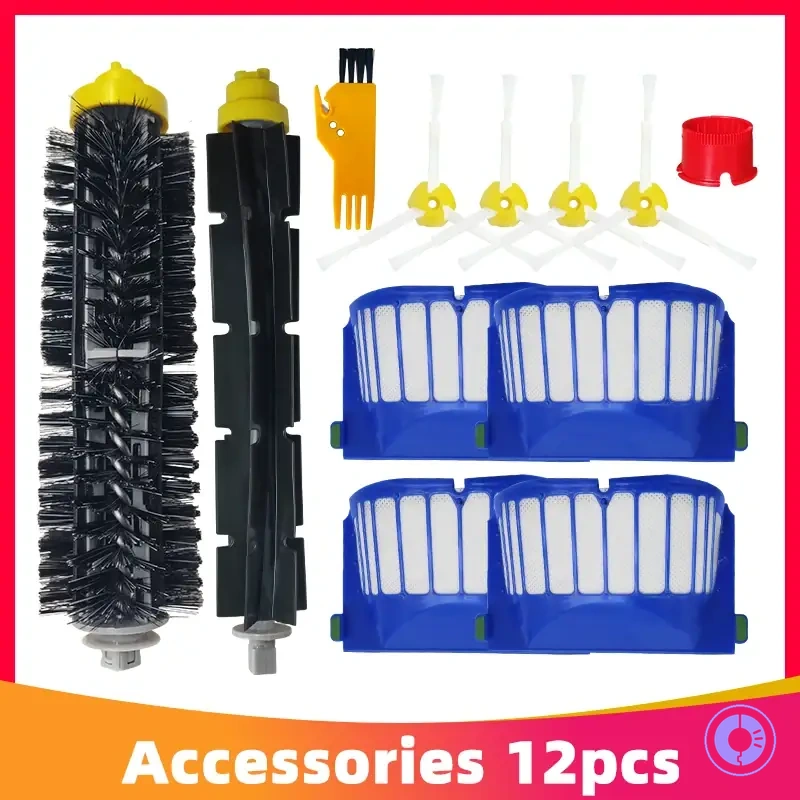
This chart shows three common pricing traps—padded bundles, broad compatibility claims, and incomplete comparisons—that inflate costs when buying Roomba replacement parts.
Model mismatch traps that create repeat buying and inflated costs
Model mismatch often leads to repeat buying and inflated costs when listings contain vague fit claims or missing series detail.
Listings that say 'compatible with most Roomba models' without specifying the series range are a common warning sign. Other red flags include:
- No mention of the specific series (e.g., 500, 600, 800, 900, i, j, s series) in the title or description.
- Photos that show a different connector shape or mounting layout than the original part.
- Customer reviews that mention 'did not fit my model' or 'had to return and reorder.'
Missing series detail is the primary warning sign because it makes the buyer guess about fit, leading to return friction and the cost of a correct replacement.
Inflated bundles that pad quantity without improving replacement utility
Inflated bundles can increase part count without increasing usable replacement coverage.
These clues can help spot padded-quantity patterns:
- Usable inclusions vs padding. Check if the bundle mixes high-use and rarely-needed parts, inflating the count.
- Quantity clarity. Repeated parts without intended use lower effective replacement value.
- Missing high-frequency items. Omitting parts you replace often (e.g., filters or brushes) while duplicating less critical ones reduces value for money.
Not every large bundle is wasteful, but you can spot padded quantity patterns when the usable count and frequency of need don't match the stated part number.
Urgency buying and narrow comparison scope as avoidable cost drivers
Urgency raises the overpay risk by cutting verification short. That gap between impulse and verification is where avoidable cost enters the purchase.
A minimal practical comparison scope helps prevent that gap. Before committing to a price, confirm at least the following:
- Series fit: does the part match the specific Roomba series listed in the product details?
- Quantity required: does the listing include the number of units the model actually needs?
- Physical dimensions: do the stated measurements match the space in the existing assembly?
- Connector type: does the interface match the original part without modification?
Skipping fit checks or ignoring terms like return policy or compatibility notes can push the expected cost upward. A part that does not fit or arrives in the wrong quantity can result in return shipping, restocking fees, and lost time. The lower headline price may no longer represent value once those costs are added.
A quick checklist for choosing the best-value parts offer
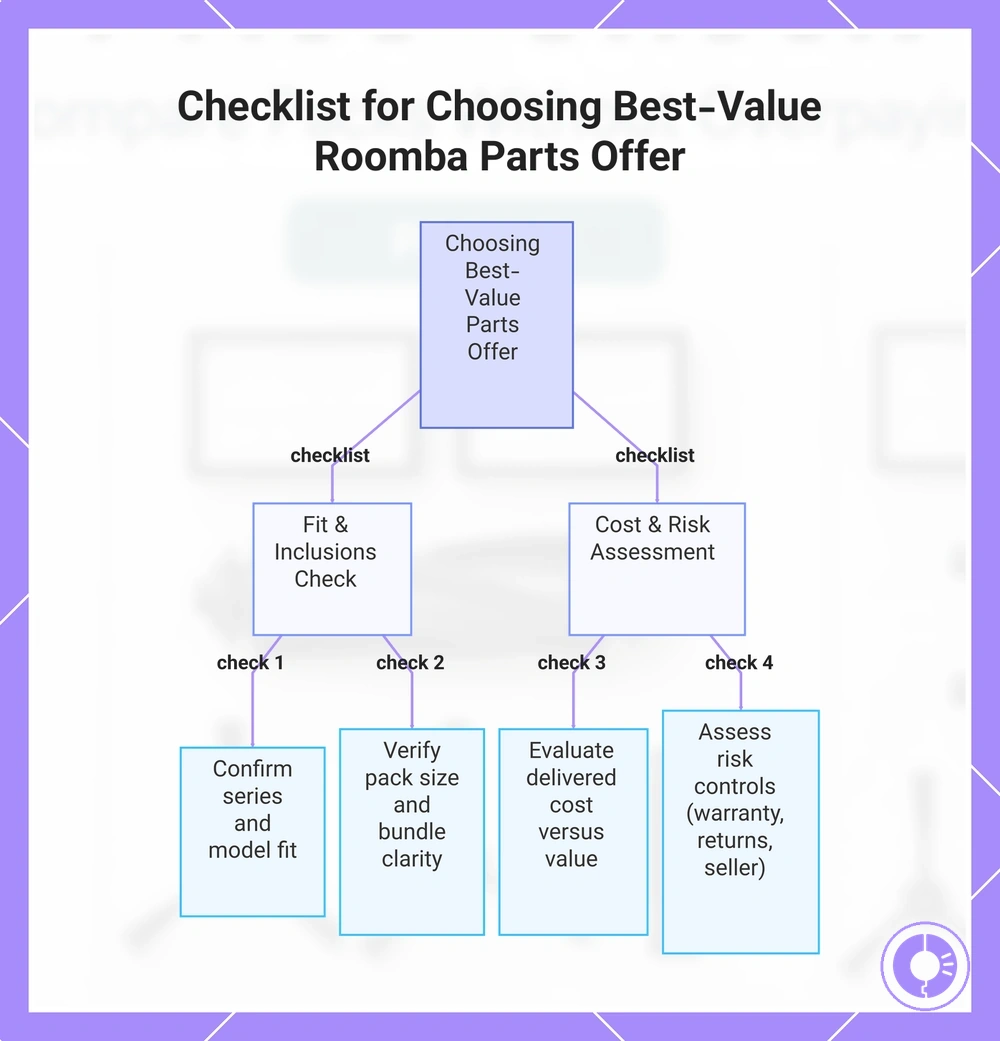
This checklist helps you select the best value by verifying fit, inclusions, delivered cost, and risk controls before ordering Roomba replacement parts.
- 1. Confirm series and model fit — check the exact Roomba model number and compatible part numbers from the manufacturer or a trusted source.
- 2. Verify pack size and quantity — ensure the order includes the correct number of components for the intended replacement.
- 3. Check bundle composition clarity — confirm whether the offer includes all necessary hardware, adaptors, or additional accessories.
- 4. Evaluate delivered cost, including shipping and taxes, against overall value — the cheapest price may not be best value if returns are needed.
- 5. Assess risk controls such as warranty coverage, return policy, and seller reputation to protect the purchase.
This chart shows a quick checklist for selecting the best-value Roomba replacement parts offer by verifying fit, inclusions, cost, and risk controls.
Here are product examples that may make comparison easier. Before buying, always review the compatibility criteria, essential features, and product details.
Minimum Pre-Purchase Checks: Fit, Inclusions, Total Cost, and Seller Terms
To make a value-safe purchase, you need to confirm fit, audit inclusions, calculate total cost, and review seller terms. Each check has a clear pass/fail outcome that affects cost and usability.
- Confirm fit for intended purpose. Passing means you can use the item as expected for your specific activity; failing may mean it is unsuitable and requires costly adjustments or a difficult return.
- Verify exact specifications (e.g., model series, size). Passing confirms compatibility with your existing setup; failing can lead to wasted time and return shipping fees.
- Check what is included in the purchase price. Passing means no surprise costs for missing parts; failing may force you to buy extras to make it usable.
- Review total delivered cost (shipping, taxes, handling). Passing gives budget certainty; failing can inflate the final price beyond what you planned.
- Read seller terms on refunds, returns, and warranties. Passing provides clear recourse if the item fails a pre-purchase inspection; failing may leave you with no remedy.
- Understand any "as-is" clause. Passing means you knowingly accept the risk; failing to understand it may mean you lose the right to claim later defects.
- Verify the item's condition through available grading or photos to avoid paying more than it is worth. Passing ensures the price matches the condition; failing may mean overpaying for hidden flaws.
- Ask about quantity or pack size when applicable. Passing confirms you receive the full count; failing may mean you pay for more than you get or run short immediately.
Tie-breakers when two offers look equal on price
When two offers for replacement parts show the same price, choose the one with lower risk and higher expected utility. Earlier items reduce uncertainty more reliably, but individual risk tolerance can shift the order.
- Compatibility certainty. Clear statements of exact series, model numbers, and fit conditions reduce wrong-purchase risk; narrow, specific coverage outweighs vague claims.
- Bundle composition and pack size clarity. Exact unit counts, included accessories, and package variant listed without ambiguity clarify cost per part and avoid hidden gaps.
- Return friction. A straightforward return policy with no restocking fees or short windows lowers the cost of a wrong decision; higher friction can turn a price tie into worse overall value.
- Inclusion usefulness. Included items (mounting hardware, cables, adapters, documentation) affect immediate usability; missing essentials shift future expenses.
- Listing clarity. Detailed descriptions, real images, and explicit condition notes (new, OEM, compatible) reduce interpretive risk; vague listings hide inconsistencies.
- Seller reputation and shipping speed. These softer signals matter most when the first five items are equal; faster, traceable shipping and consistent reviews tip the balance.